PANTS ON FIRE
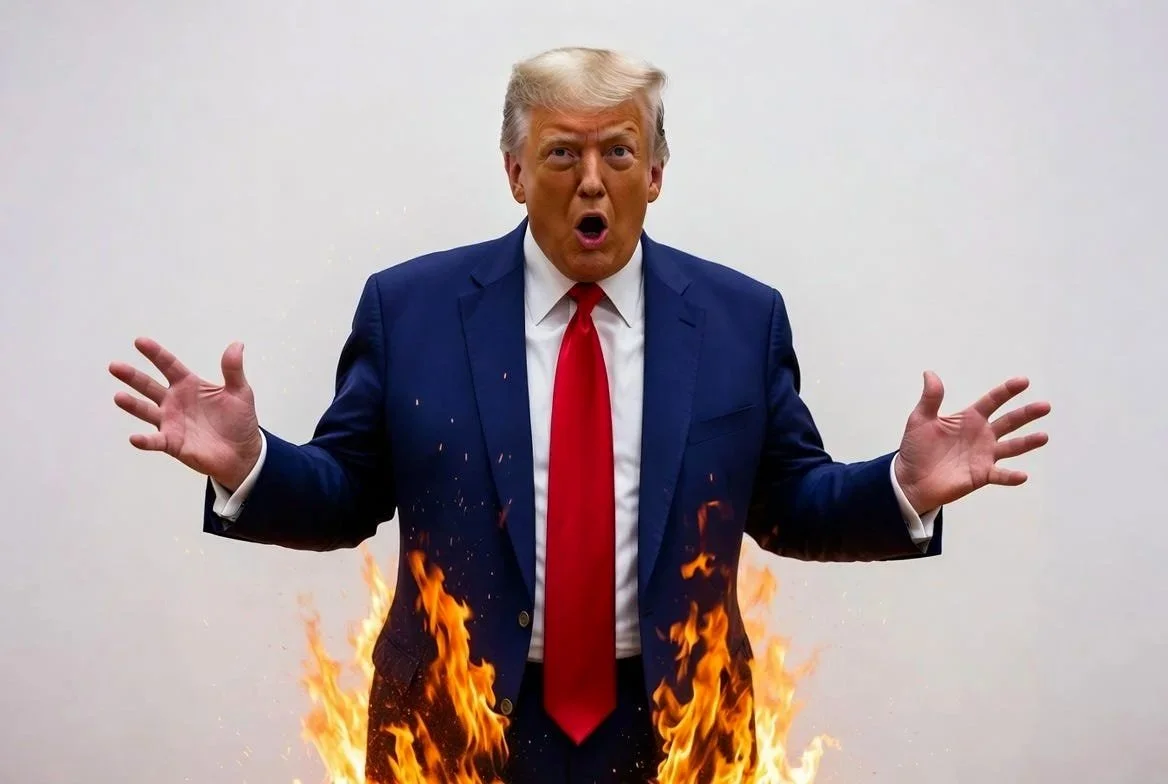
Image by Grok
Fact-checkers struggle to keep up with the pace of Trump's lies as he barrels through rallies, interviews, and late-night social media posts with an unrelenting torrent of exaggerated crowd sizes, fictional economic miracles, conspiracy-laden tales about election fraud that never materialised, and imaginary endorsements from world leaders who had actually denounced him.
First Term Total: The Washington Post Fact Checker documented 30,573 false or misleading claims over four years—an average of roughly 21 per day.
The Trend: His rate of claims increased significantly over time, peaking during the 2018 midterms, his first impeachment, and the 2020 election.
Second Term (Early 2025–2026): No comprehensive running tally exists for Trump’s second term (2025–present), unlike the first term’s 30,573. The Washington Post cited the sheer resource intensity of the first-term effort.
Here are 50 of the best, IMHO.
“I won the 2020 election.” (Repeated hundreds of times; dozens of court cases found no evidence of fraud sufficient to change the outcome).
“Dead people voted by the thousands.” (Investigations in states like Georgia and Arizona found only handfuls of such cases, often involving family members of the deceased).
“The 2024 election was also rigged.” (Pre-emptive and post-election claims regarding voting machines).
“I had the largest inauguration audience in history.” (Photos and transit data showed it was significantly smaller than previous ones).
“Tariffs are paid by China.” (Tariffs are taxes paid by the domestic companies importing the goods, often passed to consumers).
“I’ve secured $18 trillion in new investment since returning to office.” (2025 claim; internal White House data and independent economists placed the figure much lower, under $9 trillion).
“The U.S. has the highest taxes in the world.” (The U.S. is actually in the bottom third of developed nations for tax-to-GDP ratio).
“We have the best economy in the history of our country.” (The 1950s and late 1990s saw higher GDP growth and lower unemployment).
“Grocery prices are down 20% this month.” (2025 claim; CPI data showed prices were still rising or flat).
“I ended seven wars.” (2025 claim; while troop levels changed, these conflicts, such as those in Yemen or Syria, were either ongoing or resolved by other parties).
“NATO countries owe us hundreds of billions of dollars.” (NATO members don’t pay the U.S.; they agree to spend a percentage of their own GDP on their own defence).
“The Wall is almost finished, and Mexico is paying for it.” (Only about 450 miles were built, mostly replacing old barriers, and it was funded by U.S. taxpayers).
“Iran was minutes away from a nuclear weapon when I took over.” (Intelligence agencies stated Iran was complying with the JCPOA at that time).
“COVID-19 will disappear like a miracle.” (Stated early in 2020 before the U.S. reached millions of cases).
“Windmill noise causes cancer.” (There is no medical evidence to support this).
“The Green New Deal will cost $100 trillion.” (An extrapolation based on non-existent legislation; actual estimates varied wildly).
“We have the cleanest air and water ever.” (Environmental indices showed air quality actually declined slightly during his first term).
“I hardly know [Individual X].” (Used for various associates like Lev Parnas, George Papadopoulos, or E. Jean Carroll, despite photos or long histories of interaction).
“The Mueller Report found ‘No Collusion, No Obstruction’.” (The report explicitly stated it did not exonerate him on obstruction).
“I turned down a meeting with the Koch brothers.” (The brothers stated they never requested one).
“My father was born in Germany.” (Fred Trump was born in New York; Donald’s grandfather was born in Germany).
“We have no inflation right now.” (Stated in late 2025 while inflation was still around 2.5–3%).
“Foreign countries are emptying their mental institutions into the US.” (A frequent 2025 claim with no data or evidence provided by border agencies).
“I saved the city of Portland from burning to the ground.” (The city was never “burning to the ground”; clashes were localised to a few blocks).
“Prescription drug prices have dropped 500%.” (Mathematically impossible; a 100% drop would make them free).
“Hamas was going to get $50 million in condoms from the U.S.” (2025 claim; no such aid package existed).
“Every world leader called to congratulate me on the $18 trillion.” (G7 leaders’ offices denied making such calls).
“I am the most popular president in the history of the Republican party.” (Polling shows this to be incorrect).
“The Forest Service is being restructured to save $1 trillion.” (Budget experts noted the entire agency’s budget is only about $10 billion).
“I was the one who actually started the ULC (Universal Licensing Commission)[unconfirmed policy acronym].” (Often invents or misattributes policy initiatives to himself).
“Iran was right at the doorstep of a nuclear bomb before we struck.” While Iran had increased enrichment after the 2018 withdrawal from the JCPOA, intelligence reports in early 2026 indicated they had not yet made the final “breakout” to weapons-grade 90% uranium, nor had they mastered the miniaturisation required for a warhead.
“We have totally obliterated Iran’s nuclear production capability.” Following the June 2025 strikes, imagery and experts confirmed significant damage to sites like Natanz and Fordow, but noted that the program’s decentralised nature and underground facilities meant capabilities were “set back,” not “obliterated.”
“The U.S. is now totally independent of Middle Eastern oil and unaffected by their turmoil.” While the U.S. is a top producer, it still imported roughly 8.5% of its oil from the Persian Gulf in 2025. Furthermore, oil is a global commodity; domestic gas prices spiked over $4.00 a gallon in April 2026 specifically due to the war’s impact on global markets.
“Obama gave the Iranians $1.7 billion in cash for hostages.” This claim persisted from his first term. The money was actually Iran’s own funds, frozen since 1979, which the U.S. returned as part of a legal settlement at the Hague to avoid much higher interest payments.
“Iran would have had missiles reaching the American homeland by now if I hadn’t acted.” Aerospace experts have consistently stated that while Iran has a robust short-to-medium range ballistic missile program, they were years away from an ICBM capable of reaching the U.S. mainland.
“Regime change was never our goal for Operation Epic Fury.” Despite this 2026 claim, his administration frequently demanded “unconditional surrender” in early 2025, and senior officials openly discussed “neutering the regime” to the point of collapse.
“Most of Iran’s naval power has been sunk.” While the Iranian Navy suffered losses in the initial weeks of the 2026 conflict, substantial portions of their small-boat “swarm” fleet and submarine assets remained active in the Strait of Hormuz.
“The JCPOA nuclear deal gave Iran a legal right to a nuclear weapon.” The deal explicitly prohibited Iran from ever seeking or developing nuclear weapons; the “sunset provisions” only referred to limits on the level of enrichment for peaceful energy.
“I should have a say in who Iran chooses as their new Supreme Leader.” Following the 2026 strike that killed Ayatollah Khamenei, Trump claimed a legal or customary right to oversee the succession, which has no basis in international law or the Iranian constitution.
“Iran was minutes away from a nuclear weapon when I took over in 2017.” At the time of his first inauguration, the IAEA and U.S. intelligence confirmed Iran was fully complying with the nuclear deal and was at least a year away from any potential “breakout.”
“The world’s number one sponsor of terror is now broke and can’t fund proxies.” While sanctions severely crippled Iran’s economy, groups like Hezbollah and the Houthis continued to receive funding and advanced weaponry throughout 2025 and 2026.
“We have destroyed 100% of Iran’s drone manufacturing base.” Despite massive strikes on factories in early 2026, intelligence suggests mobile production units and external supply chains (including parts from Russia and China) have kept their drone program operational.
“Every world leader agreed that the 2025 bombing was necessary.” Several key allies, including France and Germany, issued statements of “grave concern” and called for immediate de-escalation rather than supporting the military action.
“The war in Iran is nearing completion and will be over ‘shortly’.” This phrase was used in April 2026 even as military analysts warned of a protracted “shadow war” and the possibility of a ground invasion.
“Iran violated the nuclear deal multiple times before I withdrew.” Prior to the 2018 U.S. withdrawal, Trump himself had twice certified to Congress that Iran was in compliance, and the IAEA issued 11 consecutive reports confirming that Iran was following the rules.
The MIT Connection: Trump frequently cites his uncle, John Trump—who was indeed a distinguished professor at MIT—as proof of his own “good genes” and innate understanding of complex science. However, in July 2025, he told a bizarrely specific and fictional story claiming his uncle had personally taught the “Unabomber,” Ted Kaczynski, at MIT. Records show Kaczynski never attended MIT; he went to Harvard and the University of Michigan, and there is no evidence the two ever crossed paths in a classroom.
The Wharton Class Rank: For decades, Trump has claimed he graduated “first in his class” or with the “highest grades possible” from the Wharton School at the University of Pennsylvania in 1968. However, the 1968 Commencement Program and the Dean’s List from that year do not list his name among the top 15% of students, nor did he graduate with any honours (cum laude, magna, or summa).
The Birthplace of His Father: On multiple occasions—most notably in 2019 and again during his second term while criticising European allies—Trump has stated that his father, Fred Trump, was born in a “very wonderful place in Germany.” In reality, Fred Trump was born in the Bronx, New York. It was Donald’s grandfather, Friedrich Trump, who was the German immigrant.
The “Self-Awarded” Peace Prize: In late 2025, after being frustrated by not receiving a Nobel Peace Prize, Trump appeared in a televised event where FIFA (the soccer governing body) presented him with a specially invented “Peace Award.” Critics pointed out that the award seemed to be created specifically for the photo-op, during which he was filmed effectively putting a medal around his own neck while claiming it was “more prestigious” than the Nobel.
The Medical “Greatest Ever” Claim: Trump famously dictated a letter to his former physician, Harold Bornstein, stating that, if elected, He would be “the healthiest individual ever elected to the presidency.” Bornstein later admitted that Trump had dictated the entire letter himself, including the hyperbolic claims about his physical strength and stamina, which the doctor simply signed.
There is extensive expert commentary from psychologists, psychiatrists, political scientists, and analysts on why Donald Trump makes false or misleading statements at such a high volume.
Experts generally describe it as unprecedented in scale for a U.S. president, but explanations vary. They fall into psychological, strategic/political, and habitual categories. No single consensus exists, and remote diagnoses are controversial (many professionals reference the “Goldwater Rule” against diagnosing public figures without examination).
Psychological Explanations:
Pathological or compulsive lying: Often linked to personality traits like narcissistic personality disorder or malignant narcissism (narcissism + antisocial traits, paranoia, sadism). Lies are seen as self-aggrandising, protective, or reality-distorting to maintain a grandiose self-image. Trump reportedly convinces himself that statements “ought to be true.”
Duping delight: Some with low empathy (narcissists/psychopaths) derive pleasure from fooling others, showing little shame or anxiety. Lies serve multiple purposes at once (self-serving + cruel).
Loose grip on reality/self-deception: Lies aren’t always calculated; some are impulsive or believed in the moment. Repetition reinforces them internally.
Psychologists like John Gartner and Lance Dodes in The Dangerous Case of Donald Trump, have publicly analysed these patterns.
Strategic and Political Explanations
“Blue lies”: Falsehoods told to benefit one’s group, strengthening in-group bonds even if antisocial toward outsiders. Partisanship can make supporters prioritise loyalty over truth.
Illusory truth effect: Repetition makes claims feel true over time, overwhelming people’s fact-checking capacity (cognitive load). Trump repeats claims relentlessly.
Habit from business/media: Long before politics, associates described him as using “truthful hyperbole” for sales, branding, and attention. Lying became normalised and effective.
Other Insights
No shame mechanism: Unlike typical liars who feel guilt or craft defensible stories, Trump often states falsehoods bluntly and moves on.
Moment-to-moment reactivity: Some see it as unprincipled improvisation rather than deep pathology, shifting to please the immediate audience.
These are professional analyses based on public behaviour, not formal clinical diagnoses. Critics argue some commentary is politically motivated, while others say the pattern demands discussion given its impact on democracy and public trust. For deeper reading, sources like Psychology Today, The Conversation, and Politico offer detailed takes.
Why is MAGA going along for the ride?
Experts frame it as human psychology under polarisation - loyalty, identity, and emotion often outweigh the pursuit of abstract truth. Supporters typically see themselves as rejecting “elite lies” in favour of a fighter who validates their worldview. It’s not (mostly) stupidity; it’s motivated cognition common in intense political tribes. For deeper dives, see work by Jonathan Haidt and studies in Political Psychology.
