JUST A VIAL OF PISS
Crisafulli has spent weeks saturating social media with a three-word slogan: “drill, refine and store”. It is short, punchy, marketable, and perfectly designed for political soundbites. But beyond the branding exercise, the public is still waiting for the most basic details. What exactly is the plan? What minerals are being targeted? Where will they come from? Who will pay for it? What infrastructure is required? What environmental safeguards will exist? What are the projected returns? And perhaps most importantly, is any of it actually operationally or economically viable?
So far, Queenslanders have been given slogans instead of substance. Ironic given his reputation for banning them.
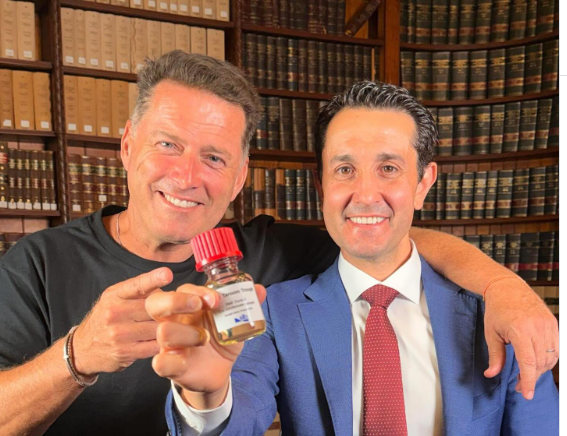
The entire campaign increasingly feels like a political marketing exercise built around imagery rather than evidence. The repeated appearance of a small vial of yellow liquid in promotional videos and photo opportunities has become symbolic of the problem itself. It is presented as though it represents technological progress and economic certainty, yet no serious explanation accompanies it. Without context, scientific detail, feasibility studies or independent verification, it may as well be anything at all. A prop is not a policy.
If a government is serious about transforming Queensland into a global refining and energy-storage powerhouse, there should already be publicly available modelling from economists, mining experts, engineers, environmental scientists and energy analysts. There should be projections showing anticipated demand, export markets, infrastructure costs, energy requirements, water usage, waste management plans and long-term profitability. Instead, the public is being asked to accept sweeping claims on faith alone.
Mining and refining are not simple political buzzwords. Refining in particular is extraordinarily expensive, energy-intensive and technically difficult. Australia has long exported raw materials precisely because large-scale domestic refining often struggles to compete internationally against countries with lower labour costs, cheaper energy, established industrial ecosystems and decades of specialised infrastructure investment. Building that capacity from scratch is not impossible, but it is certainly not something that can be wished into existence with a slogan.
Then there is the question of storage. Storage of what, exactly? Battery minerals? Strategic fuel reserves? Hydrogen? Processed rare earths? Carbon? Each possibility involves completely different technologies, risks, infrastructure needs and market realities. Yet the messaging remains intentionally vague, perhaps because specificity invites scrutiny. And scrutiny is exactly what is missing.
Governments routinely commission independent reports for projects far smaller than the ambitions now being promoted online. Large infrastructure proposals usually include cost-benefit analyses, parliamentary inquiries, environmental impact statements, and consultations with industry experts. Here, however, Queenslanders are being sold a vision without seeing the blueprint.
There is also a broader political pattern at work. Modern politics increasingly operates through branding rather than policy depth. Complex economic questions are compressed into simplistic catchphrases that poll well on social media and talkback radio. “Drill, refine and store” joins a long list of political slogans designed to create the impression of decisive leadership while avoiding the harder conversations underneath. It sounds strong. It sounds productive. It sounds economically ambitious. But slogans are not economic strategies.
The reality is that major industrial transitions are enormously complicated. If Queensland genuinely wants to position itself within future critical mineral supply chains, there are legitimate discussions worth having. How do we avoid repeating the historic mistake of exporting raw resources while other countries capture the higher-value manufacturing profits? How do we ensure regional communities benefit rather than multinational corporations alone? How do we protect water systems, farmland and ecosystems from intensified extraction? How do we guarantee that public money is not funnelled into projects that primarily privatise profits while socialising risk?
These are serious questions deserving serious answers.
Instead, much of the public discussion has been reduced to visual theatre and repetitive messaging. The implication seems to be that simply invoking mining and industry will automatically generate prosperity. But history is littered with resource booms that enriched corporations while leaving ordinary people with degraded environments, inflated housing costs, overstretched infrastructure and very little long-term economic security.
Queenslanders should not be criticised for asking basic questions before embracing another grand industrial promise. Scepticism is not anti-development. It is what responsible citizenship looks like. If billions of dollars, environmental risks and long-term economic planning are involved, transparency should be the minimum expectation, not an unreasonable demand.
At this stage, the government appears to be asking the public to confuse confidence with competence. A slogan is not a feasibility study. A media clip is not an economic plan. And a mysterious vial of yellow liquid is certainly not evidence that a coherent, viable and independently verified strategy exists.
If the plan is real, show the modelling. Show the costs. Show the risks. Show the independent expert analysis. Show Queenslanders exactly what will be mined, refined and stored — and explain why any of it makes economic sense in a rapidly changing global market.
.
