SHE WON’T CUT IT
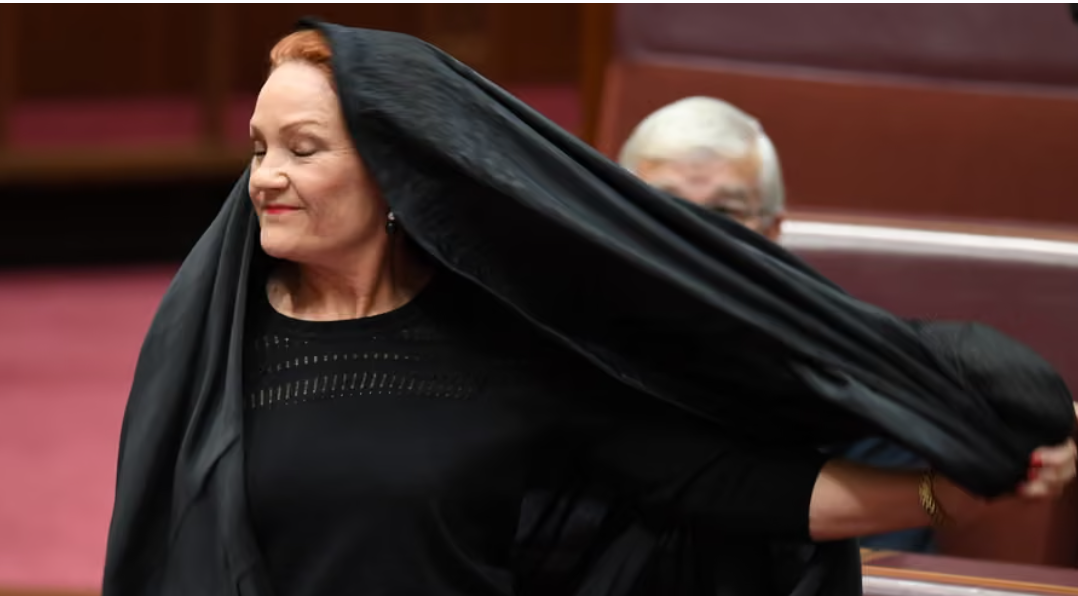
Image: Townsville Bulletin
You’d have to be a dead set drongo to believe that a Pauline Hanson-led government could lead us through another global financial crisis, another pandemic, military conflict, natural disasters or strained relations with other nations. Where’s the depth?
Yes, a political party is shaped by its policies, but also by the people it chooses to support and promote. With Pauline Hanson’s One Nation, the ongoing involvement of individuals with a complete lack of depth and questionable conduct suggests a pattern that goes beyond one-off mistakes and reflects on the party’s standards. Taken together, repeated problems with integrity, judgement, experience, and past actions point to deeper failures in ensuring quality representation. This puts the foundation of democratic governance at risk.
Integrity stands out as the most urgent issue. Several people connected to Hanson have been accused of behaviour that, even if not criminal, is considered unethical or inappropriate. James Ashby, her long-time chief of staff, was at the centre of the 2019 NRA scandal. He and others were filmed seeking money from American gun lobby groups while talking about changing Australia’s gun laws. No charges were brought, but the incident raised real concerns about foreign influence and putting political gain ahead of the national interest. Ashby has also faced accusations of overcharging candidates, intimidating party members, and keeping “dirt files” for leverage. These claims reinforce the view that the party’s culture values control over transparency.
It is also concerning when people with serious criminal convictions or allegations are welcomed or kept in the party. For example, Sean Black was convicted in 2018 of rape and assault against his then-wife and served time in prison. He was later rehired for advisory and campaign roles. This choice sends a clear message about what the party values, especially in a country dealing with a domestic violence crisis. It raises doubts about whether winning elections is put ahead of basic ethics.
Other examples reinforce this pattern. Donald Bundesen was reported to the National Anti-Corruption Commission after claims he made money by referring struggling farmers to legal services, possibly taking advantage of vulnerable people he met through his parliamentary work. Steve Dickson, another senior member, resigned after a video showed him behaving inappropriately at a strip club, adding to earlier concerns from the NRA incident. These are not small mistakes; they show a repeated acceptance of behaviour that would end political careers elsewhere.
Concerns about integrity go back to the party’s beginnings. Hanson was convicted in 2003 of electoral fraud related to party registration and funding, though this was later overturned on appeal. This points to early problems with how the party was run. Since then, she has been involved in controversies over racial discrimination rulings, inflammatory public comments, and repeated defences of staff who have acted badly. All of this suggests that the party often avoids taking responsibility.
Another big concern is judgement and critical thinking, not just formal education. Some candidates and associates have shown poor judgement or have engaged with extremist or conspiracy theories. For example, Tyler Green has published material that refers to antisemitic conspiracy theories and Holocaust denial. Dean Smith was secretly recorded making extreme anti-immigrant comments and was reportedly considered by a neo-Nazi group. These are not just random online posts; they come from people who want or have real political power.
Allowing these kinds of views weakens public trust in good government. It shows the party is open to populist slogans instead of evidence-based policies and tends to attract people whose views do not fit responsible democratic debate.
Experience, or lack thereof, is also a problem. Good government needs more than passion; it needs skill, knowledge of systems, and the ability to handle complex policies. Several One Nation members have shown they were not ready for public office or did not meet basic eligibility rules. For example, Rod Culleton lost his seat after the High Court found him ineligible due to a past conviction, causing immediate instability. Heather Hill was also disqualified for failing to properly renounce dual citizenship. The repeated selection of legally ineligible or controversial candidates undermines party effectiveness and wastes public resources.
Past performance, which often predicts future behaviour, adds to these worries. The party’s history includes infighting, resignations, and public arguments. Brian Burston left after disagreements with Hanson, and David Oldfield was expelled amid a rivalry, highlighting a pattern of instability and factionalism. Even the party’s financial deals have raised concerns, like leaked agreements suggesting large exit fees for elected members, as in Dane Sorensen’s case. These actions make it seem like the party cares more about control than about representing voters.
Overlaying all of this are numerous cases involving allegations or convictions related to violence, particularly domestic violence. Figures such as Ben Dawkins and Adrian Deeth have faced legal consequences related to restraining order breaches, while others, including Torin O’Brien and Bruce Preece, have been linked to assault or domestic abuse allegations. The recurrence of such cases within a single political network raises legitimate concerns about candidate selection standards and the messages being sent to the broader community.
All these issues matter even more when thinking about what could happen if One Nation gains more seats in parliament. More members would not just mean more of their policies, but also more influence from a political culture that seems to accept ethical failures, poor judgement, and instability. This could lead to weaker checks on laws, less trust in democratic institutions, and the normalising of behaviour that does not meet public standards.
Parliament needs a basic level of honesty and skill to function properly. When that standard drops, the effects are real. Decisions may be based on ideology instead of facts. Vulnerable groups can become even more marginalised. People may lose trust in the government. In a time already marked by misinformation and political division, these risks are serious.
This doesn’t mean that everyone linked to One Nation has issues, or that other parties have no controversies. Still, the number and regularity of these issues in Hanson’s circle stand out. It suggests there are deeper problems in the system, not just one-off cases, and raises an important question for voters: what standards should we expect from those who want to represent us?
Hanson has also maintained a notably close relationship with Gina Rinehart, one of Australia’s wealthiest and most influential mining figures, raising questions about the extent to which her political positions align with or are influenced by powerful private interests. While such associations are not uncommon in politics, the visibility of this relationship and the way she unashamedly flaunts it adds to broader concerns about independence, transparency, and whose interests are ultimately being prioritised.
In the end, democracy depends not just on policies but on whether those in power can be trusted. Integrity, judgement, experience, and past actions are indicators of whether they will really serve the public. When a party consistently fails in these areas, it threatens the strength and legitimacy of the whole political system.
