THE PROBLEM(S) WITH SEGAL
In a joint statement with the Zionist Federation of Australia on 12 November 2023, Jillian Segal criticised Foreign Minister Penny Wong and the Albanese government for urging Israel to stop attacking Gaza hospitals and for supporting a ceasefire. The statement called such criticism a “libel,” claiming the hospital attack allegations were unfair and that Australia should avoid legitimising narratives that “demonise” Israel. This intervention alone raises important questions about how Segal views dissent, criticism of state violence, and the line between antisemitism and political disagreement.
Australia’s appointment of Jillian Segal as Special Envoy to Combat Antisemitism was presented as a move towards social cohesion amid rising tensions and polarisation. On the surface, the role appears reasonable. Antisemitism is real. It exists across the political spectrum, has increased in many countries, and deserves serious attention from governments and civil society alike. Jewish people should be able to live free from harassment, intimidation, hatred and violence, just like every other community.
But almost immediately after Segal’s appointment, concerns emerged about whether she was the right person for the role and, more broadly, about the position's direction and purpose.
Segal’s background is deeply tied to Australia’s political, corporate, and institutional establishment. She is a corporate lawyer, former National Australia Bank board member, former UNSW deputy chancellor, and past president of the Executive Council of Australian Jewry. This is not the background of a grassroots anti-racism campaigner or a community-level bridge-builder; it is that of someone connected to elite power. While this does not disqualify her, it shapes her approach: institutional, top-down, and aligned with established centres of influence.
Further controversy arose when it was revealed that a company linked to her husband donated $50,000 to Advance Australia, a right-wing lobbying group known for aggressive campaigns on issues like Indigenous recognition, immigration, climate policy, and the Israel–Palestine conflict. Advance has been criticised for amplifying division and culture-war politics. Whether Segal was involved with the donation is almost secondary; the association is significant because the role depends on public trust and perceived impartiality.
Criticism has come not only from political opponents or pro-Palestinian activists, but also from civil liberties advocates, academics, and others who question whether someone so closely linked to specific networks can truly serve as a neutral national figure on racism and social cohesion.
That concern becomes even sharper when examining the substance of her proposed policy agenda. Segal has supported measures that would scrutinise universities' handling of antisemitism complaints and potentially link institutional funding to compliance with government expectations. Supporters argue this is necessary to address genuine cases of harassment and intimidation on campuses. Critics, however, fear it risks politicising universities and narrowing the space for legitimate political debate, particularly surrounding Israel, Palestine and Zionism.
This is where the debate becomes especially important. Antisemitism must be confronted firmly and consistently. But criticism of a nation-state, criticism of an ideology, or opposition to the policies of a foreign government are not automatically forms of racial hatred. If criticism of Israel or Zionism becomes increasingly treated as inherently antisemitic, then the line between protecting communities and suppressing political dissent begins to blur. In any democracy, that should concern people regardless of their political stance.
A broader question arises: Does appointing envoys for specific racisms fragment the problem? Racism’s forms, such as antisemitism, Islamophobia, anti-Indigenous, anti-Asian, and anti-African bias, often overlap. Creating distinct bureaucratic approaches for each may encourage divisions and undermine shared values of equality and justice.
Supporters say Segal’s establishment ties make her effective, giving her access to leaders and institutions. But these connections also drive scepticism. When insiders shape talks on racism, many question whose interests are protected.
Transparency is another issue. The envoy’s office carries significant symbolic authority and taxpayer funding, yet much of its work operates within opaque government processes with limited public scrutiny. Australians are entitled to ask questions about accountability, priorities, measurable outcomes and value for money. Reports suggest the office, staffing, and associated resources may cost taxpayers well over a million dollars annually, while details surrounding remuneration and operational expenditure remain unclear. At a time when many Australians are struggling with housing costs, energy bills and healthcare pressures, scrutiny of publicly funded roles is entirely legitimate.
Perception is central to the envoy role. Segal’s perceived alignment with pro-Israel positions and equating criticism of Israel with antisemitism makes her less able to unify Australia’s diverse society. Building social cohesion relies on broad empathy, not restricting political discourse.
None of this means antisemitism should be ignored or minimised. Jewish communities deserve safety and dignity. But the fight against racism loses credibility when linked to political agendas or used to shield states and movements from criticism.
A healthy society holds multiple truths: Antisemitism and Islamophobia are real and dangerous; Palestinians deserve rights and dignity; and criticism of governments and ideologies is vital for democracy.
I am Jewish, born in Israel to Holocaust survivors. I served in the IDF over half a century ago, as many Israelis of my generation were obliged to. Those years left lasting, painful memories and physical wounds that still trouble me to this day. It’s exactly that background that leads me to reject the idea that Jewish identity requires political conformity or silence. Jews are not a monolith. Many criticise Israeli policy, oppose occupation, and reject aspects of Zionism. This does not make us "self-hating" or antisemitic; it makes us part of a long tradition of Jewish debate and dissent.
No government-appointed envoy, lobby group or political movement should have the power to determine which Jews are considered acceptable and which are not. Not even the Chairman of AIJAC and lowlife, genocide-supporting, racist runt, Mark Leibler.
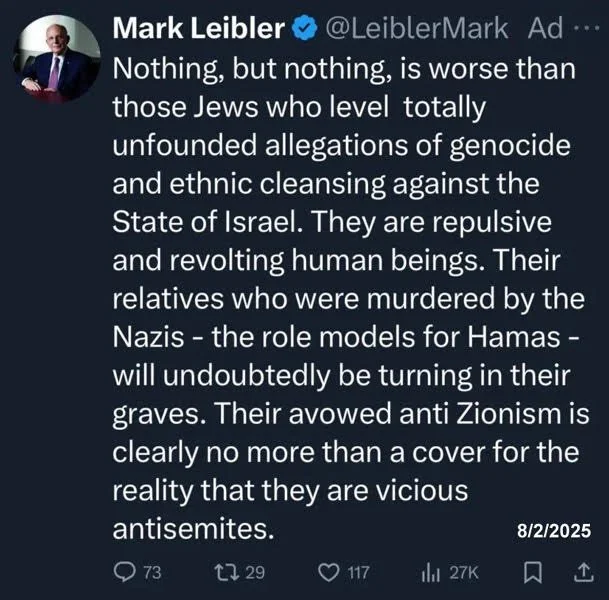
Since I started speaking out about Israel’s war crimes in late 2023, I’ve been subjected to relentless online abuse, including threats of harm. These came predominantly from the Australian Jewish community, but also from members of government-funded Australian Jewish Lobby organisations, and that warrants a Royal Commission of its own.
